
⚡ Quick Answer — How Are Electric Vehicles Towed?
Electric vehicles must be towed on a flatbed with all four wheels off the ground. Dragging an EV with its wheels on the road — even in neutral — can destroy the electric motor, damage the battery management system, and void your warranty. Repair costs from improper towing can reach $5,000–$15,000.
Call (613) 317-3924 for 24/7 EV-safe flatbed towing across Ottawa. Tell the dispatcher your vehicle is electric so we send the right truck.
✅ We transport Tesla, Hyundai, Kia, Chevrolet, Ford, Nissan, BMW, Volkswagen, and all other EV and hybrid makes.
With over 900,000 electric and plug-in hybrid vehicles now registered across Canada and Ottawa’s growing network of charging stations, EVs are becoming a common sight on the 417, in Kanata driveways, and in Barrhaven parking lots. But when something goes wrong — a dead high-voltage battery, a flat tire, a fender bender, or even just running out of charge — electric vehicle towing requires a fundamentally different approach than towing a gas-powered car.
At Towing Ottawa, we provide EV-safe flatbed towing for every electric and hybrid vehicle on the road. This guide explains why EVs cannot be towed like regular cars, what can go wrong if they are, what to do when your EV breaks down, and how much EV towing costs in Ottawa.
Why Electric Vehicles Must Be Towed on a Flatbed
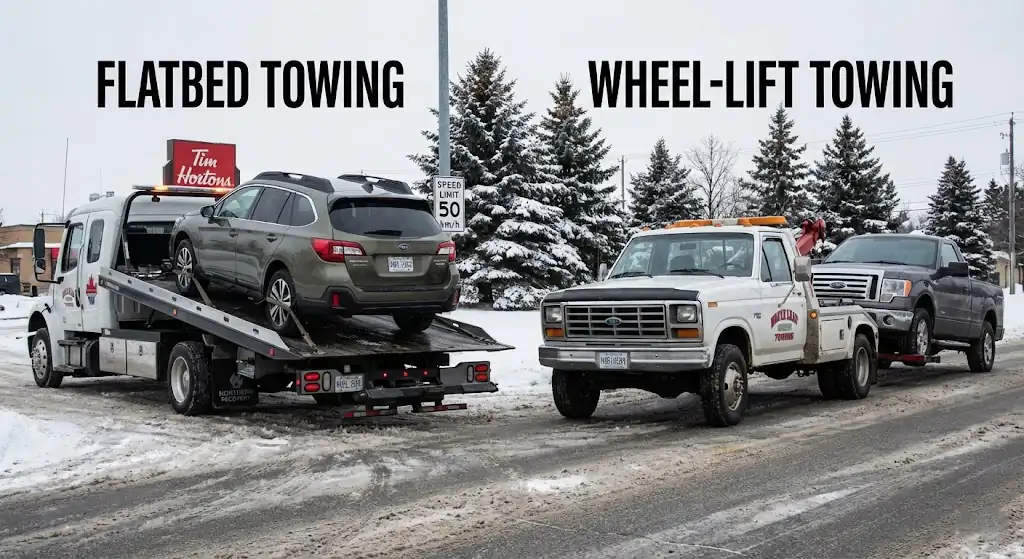
This is the single most important thing every EV owner needs to know about towing: all four wheels must be off the ground. Here is why:
⚙️ Direct Motor Connection
Unlike gas cars with a traditional transmission, EV wheels are directly connected to the electric motor. When the wheels spin — even with the car “off” — the motor generates electricity through regenerative braking. This unregulated power can overheat and destroy the motor, inverter, and power electronics.
🔋 Battery Damage Risk
The reverse electrical flow from spinning wheels pushes energy back into the battery management system (BMS) without proper regulation. This can damage battery cells, blow high-voltage fuses, or trigger thermal events. EV battery packs cost $10,000–$25,000 to replace.
📋 Warranty Requirement
Tesla, Hyundai, Kia, Ford, GM, BMW, Volkswagen, and virtually every other manufacturer explicitly require flatbed transport. Improper towing voids the powertrain warranty — meaning you pay for any damage caused, not the dealer.
🚫 Never allow a tow operator to wheel-lift, dolly-tow, or flat-tow your EV. Even “just a short distance” can cause thousands of dollars in damage. If a tow truck arrives without a flatbed, refuse the service and call us at (613) 317-3924. Under Ontario’s TSSEA, you have the right to choose your tow company.
Towing Methods Compared: What Is Safe for EVs?
EV Broke Down? We Have Flatbeds Ready.
24/7 EV-safe towing • Tesla • Hyundai • Kia • Chevy • Ford • All makes
Electric & Hybrid Vehicles We Transport
We tow every EV and hybrid on Ottawa’s roads. Each model has unique tow hook locations, transport mode procedures, and weight characteristics — our operators are trained to handle them all:
Tesla
Model 3, Model Y, Model S, Model X, Cybertruck
Hyundai
Ioniq 5, Ioniq 6, Kona Electric
Kia
EV6, EV9, Niro EV
Chevrolet / GM
Bolt EV/EUV, Equinox EV, Blazer EV, Cadillac Lyriq
Ford
Mustang Mach-E, F-150 Lightning
Nissan
Leaf, Ariya
Volkswagen
ID.4, ID. Buzz
BMW / Mercedes / Audi
iX, i4, EQS, EQE, Q4 e-tron, Q8 e-tron
💡 Hybrid vehicles (Toyota RAV4 Hybrid, Honda CR-V Hybrid, Hyundai Tucson PHEV, etc.) also benefit from flatbed towing. While some hybrids can technically be dolly-towed, flatbed is always the safest option and is what we recommend for all electrified powertrains.
What to Do When Your EV Breaks Down in Ottawa
Whether you ran out of charge on the Queensway or your Tesla threw a software error in a Kanata parking lot, follow these steps:
Pull Over Safely & Turn On Hazards
Get as far from traffic as possible. EVs are nearly silent, so other drivers may not realize you have stopped. Hazard lights are critical. See our full breakdown survival guide.
Do NOT Push or Roll the Vehicle
Pushing or rolling an EV can activate regenerative braking and generate unregulated electrical current. Leave the car where it is and wait for professional recovery.
Activate Transport Mode (If Possible)
Many EVs have a “Transport Mode” or “Tow Mode” in the settings that releases the parking brake and disables regenerative braking. Check your owner’s manual. Tesla: go to Controls → Service → Towing. Tell the tow operator if you were able to activate it.
Call for a Flatbed — Specify “Electric Vehicle”
Call (613) 317-3924 and tell the dispatcher: your exact location, that your vehicle is electric (model and year), what happened, and whether Transport Mode is active. This ensures we dispatch a flatbed with an operator experienced in EV loading.
Move the Key Fob Away From the Vehicle
Some EVs do not fully power down if the key fob is nearby. Moving it 10+ feet away prevents the car from “waking up” during loading, which can re-engage the parking brake or stability control unexpectedly.
Stay Safe While Waiting
Stay in the vehicle on highways (seatbelt on, doors locked). In parking lots, stand clear of the vehicle. In winter, conserve battery by minimizing heating — see our winter breakdown tips.
Why Do Electric Vehicles Break Down?
EVs have fewer moving parts than gas cars, so they break down less often. But when they do, the causes are different:
💡 12V battery is the #1 EV breakdown cause. Every EV has a small 12V battery (like a gas car) that powers the computer, locks, and touchscreen. When it dies, the high-voltage battery cannot activate — even if it is fully charged. A simple 12V battery boost often gets you going again. See our jump start guide.
How Much Does EV Towing Cost in Ottawa?
Because EVs require flatbed towing (which costs more than a standard wheel-lift), EV towing is generally slightly higher than a comparable gas car tow. Here are typical Ottawa prices:
💡 Check your coverage first. Tesla includes roadside assistance with warranty. Many EV manufacturers (Hyundai, Kia, Ford, GM) include complimentary roadside for 3–5 years. CAA also covers flatbed EV towing for members. Your auto insurance may have roadside assistance as well.
EV Towing Challenges in Ottawa Winters
Ottawa’s winters create specific challenges for electric vehicles that increase the likelihood of needing a tow:
❄️ Range Loss in Cold
EV range drops 20–40% in extreme cold (–20°C and below) because the battery must heat itself and the cabin. A vehicle rated for 400 km may only deliver 240–320 km in January. This leads to more “ran out of charge” calls.
🔋 12V Battery Drain
Cold weather is harder on the 12V auxiliary battery, especially if the car sits outside. If the 12V dies, the EV cannot activate its main battery pack. This is the most common EV tow call in winter.
🛞 No Spare Tire
Most EVs do not include a spare tire (to reduce weight and maximize range). A flat tire in winter often means a tow rather than a quick spare swap. See our mobile tire repair guide.
⚖️ Heavier Vehicle Weight
EVs weigh 20–30% more than equivalent gas cars due to the battery pack. This makes them harder to push out of snow and more prone to getting stuck. Our winching service handles heavy EVs safely.
To minimize winter EV issues: precondition your battery while plugged in before driving, keep your charge above 20% at all times, install proper winter tires (EVs need them even more due to their weight), and have your 12V battery tested before November.
How We Load an EV Onto a Flatbed
EV flatbed loading requires extra care compared to a standard vehicle. Here is our process:
⚡ Step 1 — Verify power state. Confirm the EV is fully powered down. Move the key fob away. Check if Transport/Tow Mode is active.
⚡ Step 2 — Locate factory tow hooks. Every EV has specific tow hook locations (often under a panel in the front bumper). We use only manufacturer-designated attachment points — never aftermarket or cosmetic parts.
⚡ Step 3 — Winch onto the flatbed slowly. The vehicle is pulled onto the deck at low, controlled speed to prevent undercarriage or battery housing contact.
⚡ Step 4 — Secure with wheel straps. Tire straps hold the vehicle in place without touching body panels, charging ports, or aero components.
⚡ Step 5 — Transport and unload. We deliver to your chosen destination — home, dealership, charging station, or repair shop — and unload with the same care.
Other Roadside Services for EV Owners
Frequently Asked Questions: Electric Vehicle Towing
Can you tow an electric car with a regular tow truck?
No. A standard wheel-lift tow truck leaves two wheels on the ground, which can damage an EV’s electric motor and battery system through unregulated regenerative braking. EVs require a flatbed (rollback) tow truck that lifts all four wheels off the ground.
What happens if my EV is towed incorrectly?
Improper towing can overheat the electric motor, damage the inverter and power electronics, push unregulated current into the battery management system, blow high-voltage fuses, and void the manufacturer’s powertrain warranty. Repair costs range from $5,000 to $15,000 or more for drivetrain components.
How much does it cost to tow a Tesla in Ottawa?
A local flatbed tow for a Tesla (or any EV) in Ottawa typically costs $120–$250 depending on distance. Tesla includes complimentary roadside assistance during the warranty period, which may cover the tow. Always check with Tesla’s app or roadside number first, or call us at (613) 317-3924.
What is Transport Mode on an EV?
Transport Mode (or Tow Mode) is a setting in many EVs that releases the parking brake and disables regenerative braking so the vehicle can be safely rolled onto a flatbed. On a Tesla, it is found under Controls → Service → Towing. Check your owner’s manual for your specific model’s procedure.
My EV ran out of charge — can you tow it to a charger?
Yes. We can tow your EV to the nearest Level 3 fast charger, a Level 2 charging station, your home, or your workplace — wherever is most convenient. Ottawa has a growing network of public chargers, and we know the locations of the closest options from anywhere in the city.
Does EV towing cost more than regular towing?
Slightly, because a flatbed truck is required. The difference is typically $20–$50 more than a standard wheel-lift tow for the same distance. However, many EV owners have manufacturer roadside assistance or insurance coverage that offsets the cost entirely.
Can hybrid vehicles be towed normally?
It depends on the type. Plug-in hybrids (PHEVs) should follow the same flatbed rule as full EVs. Standard hybrids (like Toyota RAV4 Hybrid) can sometimes be dolly-towed, but flatbed is always the safest choice. Always check the owner’s manual — or just request a flatbed to be safe.
Do you tow EVs in Kanata, Barrhaven, Orléans, and Gatineau?
Yes. We provide EV-safe flatbed towing across all of Ottawa and surrounding areas including Kanata, Barrhaven, Orléans, Gatineau, Nepean, Gloucester, Stittsville, and all rural areas. See our full service area.
Is it safe to jump-start an electric car?
You can safely jump-start the 12V auxiliary battery in an EV — this is the small battery that powers the computer and doors, not the main high-voltage battery. Never attempt to jump the high-voltage system. Our battery boost service handles EV 12V batteries safely.
How do I prevent needing a tow for my EV in winter?
Precondition your battery while plugged in before driving. Keep your charge above 20% (cold weather drains faster than expected). Install winter tires (EVs are heavier and need extra grip). Have the 12V battery tested before November. Keep a portable 12V jump pack in the car. And save our number: (613) 317-3924.
EV-Safe Flatbed Towing. 24/7.
Tesla • Hyundai • Kia • Chevy • Ford • Nissan • BMW • VW • All EVs & Hybrids